From the Blog
Brushes and Combs for Curly Hair Routines

Choosing the best brushes and combs for curly hair is less about finding one tool that works for every curl pattern and more about choosing the right tool for each stage of your routine.
The way you detangle your hair can be very different from how you section, style or finish it. You might find that one brush works best for detangling, while a wide-tooth comb is useful for sectioning and a styling brush helps shape your curls.
It’s also important to check whether a brush or comb is designed for wet, damp or dry hair, as well as considering the finish you want. Brushing curly hair can change the way your curls sit and form, so the right technique matters just as much as the tool.
Choosing brushes & combs for your curly hair routine
For detangling curly hair, a flexible brush or wide-tooth comb can help you work through sections gently. For sectioning, a tail comb and a few clips can make styling easier, while a styling brush or comb can be useful when you want to define or shape your curls using a particular technique.
The key is to work in manageable sections and choose tools that suit your hair and routine. There’s no universal rule that curly hair should always be brushed wet or never brushed dry - it depends on your curl pattern, the tool you’re using, your technique and the finish you want to achieve.
Detangling tools for curly hair
When it comes to detangling curly hair, both a flexible detangling brush and a wide-tooth comb can be useful. Neither is automatically better — the best choice depends on your curl type, how you like to detangle and whether you’re working with wet, damp or dry hair.
A flexible brush can move through the hair with a little more give, while a wide-tooth comb uses larger spaces between the teeth to separate sections. Consider the size of the sections you’re working with, how comfortable the tool feels in your hand and whether it moves through your hair without unnecessary pulling.
Always start detangling from the ends and work upwards, rather than pulling knots down through the entire length. If you come across a stubborn knot, pause and make the section smaller instead of forcing the tool through it.
The Brushworks Curly Hair Detangling Brush is one current option to consider. Always check the individual product instructions for whether it’s suitable for wet, damp or dry hair rather than assuming the name alone tells you how it should be used.
Wide-tooth combs
A wide-tooth comb can be useful for separating larger sections, distributing suitable hair products or incorporating into your shower routine when the product instructions allow. When choosing one, look at the tooth spacing, length and edge finish.
Wider spacing can work well for larger sections, while a smaller comb may give you greater control when working through individual areas.
Whichever comb you choose, avoid starting at the roots if there are knots further down the hair. Work from the ends upwards and never use the comb to force its way through a dense tangle. Gentle, controlled movements are much kinder to your curls.
Row brushes and styling brushes
A row brush features defined lines of pins or bristles and can be useful for styling techniques that involve guiding, grouping or shaping sections of curly hair. However, the number of rows isn’t the only thing to consider. Look at the pin spacing, flexibility and handle design, as well as how you plan to use the brush.
The Brushworks Nine Row Hair Brush is one current option to consider. Check the product instructions and test it on a small section first. Your results will depend on your hair, products and styling technique.
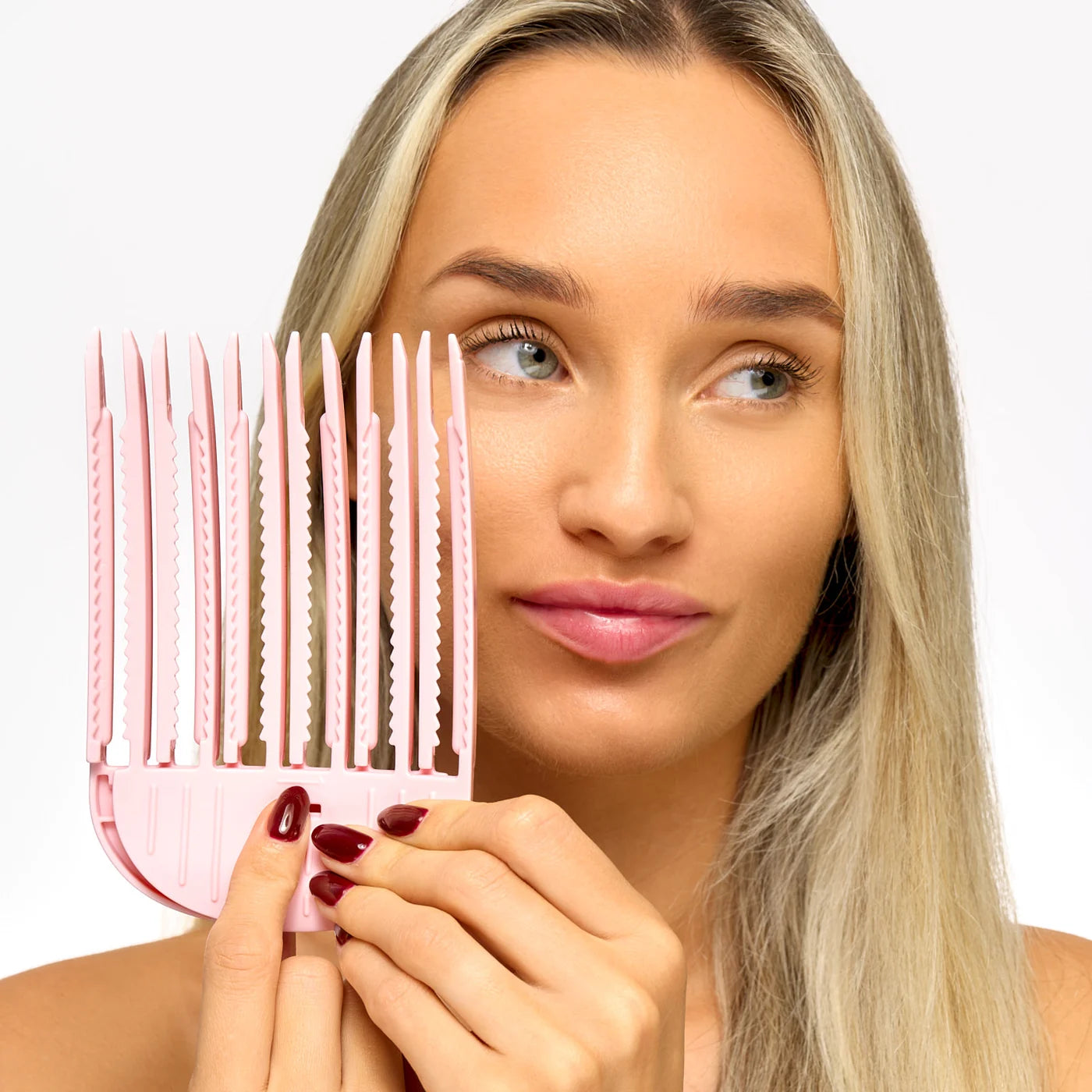
Curl combs and finishing tools
A curl comb can be useful for separating, smoothing or arranging specific areas of your hair, depending on its design. As a finishing tool, it should be used after detangling rather than pulled through knots.
Think about the finish you want — whether that’s keeping curl groups together, separating them or creating a smoother surface — and choose your tool accordingly.
The Brushworks Smoothing Curl Comb is one option to consider. Keep in mind that the final result will depend on your hair, products and technique, rather than the product name alone.
Sectioning tools
Good sectioning tools can make a curly hair routine much easier to manage, especially when detangling or styling. A tail comb can help create clean parts, while suitable hair clips keep sections out of the way without adding unnecessary tension..
A simple approach is:
- Divide your hair into larger sections using your fingers or a suitable comb.
- Secure the sections you're not working on.
- If a section feels too larger, divide it again.
- Detangle from the ends upwards where needed.
- Move on once each section is manageable and under control.
Wet, damp or dry?
There’s no one-size-fits-all answer when it comes to brushes and combs for curly hair. The best tool depends on your hair, your routine and the finish you want to achieve.
Before reaching for a brush or comb, consider:
- Is the tool suitable for wet, damp or dry hair?
- Do your conditioner or styling-product directions recommend a particular stage?
- Are you detangling, distributing product or shaping your curls?
- Can you work through your hair gently without pulling or forcing?
- Will brushing at this stage give you the curl pattern and finish you want?
Read Should You Detangle Hair Wet or Dry? for more tips.
A low-confusion curly-hair routine
A curly hair routine doesn’t need to involve lots of brushes and combs. Keeping your routine simple can make it easier to understand what works for your curls and which techniques give you the best results.
Try this straightforward approach:
- Prepare hair and product according to their instructions.
- Divide hair into manageable sections.
- Detangle gently from the ends upwards using a suitable brush or comb.
- Remove shed hair & product build up from the tool as needed.
- Switch to a styling tool only when you have a specific reason to.
- Use consistent section sizes so you can easily repeat the technique.
- Once you have achieved your desired curl pattern, avoid unnecessary brushing.
- Clean your curly hair tools and allow them to dry fully before storing.
Sometimes, fewer tools can make for a better curly hair routine, giving you a clearer idea of which products and techniques are actually making a difference.
Choose by practical details
When choosing brushes and combs for curly hair, look beyond appearance and consider how the tool will actually work with your routine.
Pin or tooth spacing: Wider spacing can work well for larger sections, while closer spacing can offer more control. Choose according to the stage of your routine.
Flexibility: Flexible pins or a flexible brush can change how the tool moves through your hair, but smaller sections may still be needed.
Head width: A wider brush covers more hair, while a narrower design can give you greater control.
Handle: Look for a comfortable, secure grip, particularly when your hands or products are slippery.
Cleaning: Styling products can build up around pins, teeth and joins, so choose a tool that’s easy to clean.
Storage: Keep teeth and pins protected from bending, and never store a damp or product-covered tool in a sealed bag.
Testing a new tool
Before using a new curly hair brush or comb across your whole head, test it on one section first. Keep your hair condition, products and section size consistent so you can see how the tool compares with your usual method.
Pay attention to whether it catches, how easily it moves through your hair and how it affects your finished curl pattern. If you find yourself needing extra force or excessive amounts of product to make it work, it may be worth reconsidering the tool, section size or stage of your routine.
Common mistakes
- Looking for one brush that claims to cover every curl routine
- Brushing in a condition not approved for the tool
- Starting detangling at the roots
- Using large sections when the tool repeatedly catches
- Pulling a tail comb through a knot
- Switching several tools without giving each a clear job
- Extending product names into unsupported promises
- Leaving styling-product residue around pins and rows
Cleaning and storage
Keeping your curly hair brushes and combs clean is an important part of your haircare routine. Remove shed hair after use and clean away any product build-up according to the product instructions.
If your tool can be rinsed, make sure it’s completely dry before storing. Check the teeth, pins, bristles and handle regularly for signs of damage, and store your tools somewhere clean and dry where they won’t be crushed or bent.
Frequently asked questions
Is a wide-tooth comb always better for curls?+
No. It is one useful option. The right spacing and technique depend on the task, section and routine.
Should curly hair be brushed dry?+
There is no answer that fits every person or finish. Check the tool instructions and consider how dry brushing changes your result.
Do I need a curl-specific brush?+
Start with the jobs you need to perform. A well-matched detangling, sectioning or styling tool is more important than a label alone.
Can the same tool detangle and style?+
Possibly, when both uses are supported and give you control. Separate tools are useful only if the jobs genuinely differ.
How should I choose section size?+
Begin smaller than the full brush width and increase only if the tool moves without catching or forced pressure.
Continue your routine
Related Brushworks guides

Should You Detangle Hair Wet or Dry? Choosing the Right Tool
Whether you should detangle hair wet or dry depends on your hair routine, the products you use and the brush...
Read guide →
How to Choose the Right Hairbrush for Your Hair and Routine
Finding the right hairbrush starts with thinking about what you actually use it for. Whether you’re detangling, smoothing, blow-drying, styling...
Read guide →Shop the guide
Recommended products
-
Curly Hair Brush
 View ProductCurly Hair Detangling Brush£8.99
 -
Nine Row Hair Brush
 View ProductNine Row Hair Brush£5.99
 -
Smoothing Curl Comb
 View ProductSmoothing Curl Comb£4.99